
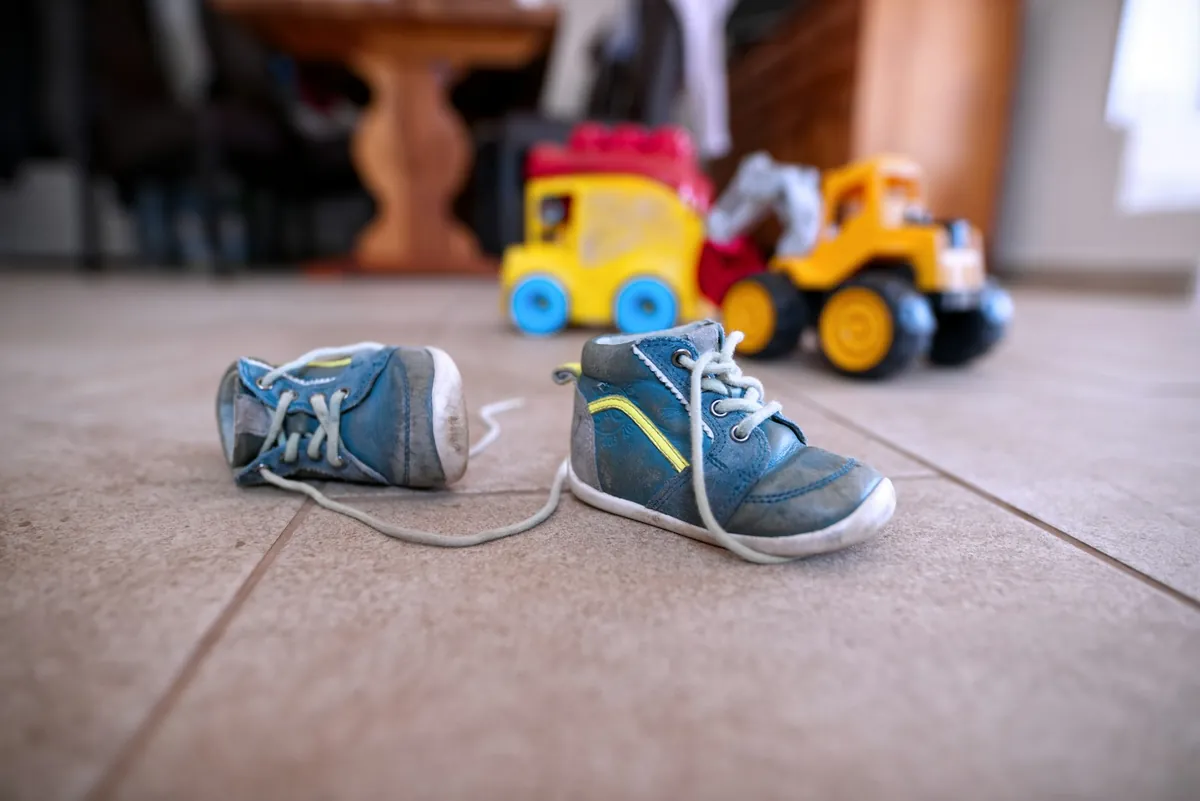
The visit went well. Everyone ate, nobody cried, and then you said the word “shoes” and the whole thing came apart in the doorway. Leaving is the hardest part of almost every outing with a toddler, and it is largely a solvable problem.

What works: leave earlier than you want to, give two warnings, use the same leaving routine every time, and give your child something to do as you go. Announcing departure with no warning to a child who is deep in play is the version that reliably fails.
Why it is hard
Young children are not being difficult about leaving; they are bad at switching. Stopping something absorbing and starting something boring is a genuine cognitive task, and under-fives are still building the skill. The Child Mind Institute’s piece on helping kids with transitions explains the mechanism well.
Two practical consequences follow. First, warnings are not a courtesy — they are the tool. Second, the tireder the child, the harder the switch, which is why leaving late goes worse than leaving early.
Leave before you need to
The most effective change is also the least appealing: go while it is still going well. A visit that ends twenty minutes early ends happily; the same visit twenty minutes late ends on the floor.
For most under-fives that means ninety minutes to two hours, and rather less on a bad night’s sleep. Watch for the early signals rather than the obvious ones — drifting between activities, more disputes, coming back to you more often. Those arrive well before the meltdown does.

The two-warning routine
- Ten minutes out: “Two more goes on the slide, then shoes.” Concrete and countable beats abstract time, which means nothing at three.
- Two minutes out: go to them, get down to their level, and say it again. Calling across a room does not land.
- At the point of leaving: start the routine rather than issuing an instruction — walk to the shoes together instead of announcing that it is time to go.
Consistency does more than any individual technique. The same three steps every time becomes something your child recognises, and recognition is what makes it easier.
Give them a job
A child with a task leaves better than one being led away. It is a small trick and it works repeatedly.
- Carry the bag, or your keys
- Press the button for the door
- Put the last toy away — a defined ending helps
- Say goodbye to something specific: the slide, the fish, the person at the counter
- Choose which way to walk back to the car
What tends to make it worse
| Common move | Why it backfires |
|---|---|
| No warning at all | Removes the one thing that helps most |
| Counting down from ten | Turns leaving into a confrontation with a deadline |
| Negotiating “five more minutes” twice | Teaches that the warning is not real |
| Leaving at the point of exhaustion | The switch is hardest exactly when they are least able |
| Threatening not to come back | Rarely credible, and makes the next visit harder |
| Rushing the last five minutes | Hurry reads as pressure and escalates everything |

When it happens anyway
Some days it will, and usually in public. The approach that gets everyone out fastest:
- Stop talking. Explanations do not reach a child mid-meltdown.
- Move. Pick them up if you need to and get outside; the change of environment does more than words.
- Wait it out somewhere quieter. Two minutes on a bench beats twenty in a doorway.
- Do not relitigate it in the car. It is over.
- Ignore the audience. Every parent in that room has had the same afternoon.
The bit nobody mentions
Leaving goes better when you are not also carrying three bags, paying a bill and looking for a lost sock. Settle the bill early, gather your things before the last ten minutes, and do the practical part while your child is still playing.
Our packing guide is partly about this: less to gather at the end is fewer things to go wrong in the doorway.

The same thing happens on the way out of the house — see coats, shoes and getting out the door.
Building it into the routine
Children who go to the same places regularly leave those places more easily, because the ending is familiar. That is one of the underrated benefits of a weekly pattern — the third visit to somewhere is almost always calmer than the first, in both directions.
Our guide to building a weekly routine covers the wider version of this.
How it changes with age
- Under two: warnings mean little. Pick them up, keep it brisk and cheerful, and accept some protest.
- Two to three: the hardest stretch. Warnings start to work, and so does giving a job.
- Three to four: countable warnings (“two more goes”) land properly.
- Four and up: most children can manage a stated finish time, especially one they agreed to on arrival.

The arrival sets up the departure
One thing that helps more than it should: say how long you are staying when you arrive, not when you leave. “We are staying until snack time, then we go home” plants the ending at a point when your child is calm and receptive, rather than introducing it as unwelcome news an hour later.
Transitions beyond the doorway
The same mechanism causes most other daily friction: getting dressed, stopping a game for dinner, leaving the park, getting out of the bath. If leaving a play space is hard, those probably are too, and the same three tools work on all of them.
- Warn in units they understand — turns, songs, pages — rather than minutes.
- Keep the sequence identical, so the routine itself carries them through.
- Move towards the next thing rather than away from the current one. “Let us go and find your boots” beats “stop playing now”.

If the difficulty starts well before the doorway, it may be overstimulation rather than the transition itself — see our guide to spotting an overstimulated toddler.
A note on your own state
Transitions go badly far more often when the adult is rushed. A parent who is already late radiates it, and a toddler reads that instantly and digs in.
The practical version of this is unglamorous: build ten minutes of slack into the plan. Most doorway battles are really a scheduling problem, and leaving ten minutes earlier almost always costs less than the argument does.
Frequently asked questions
How do I get my toddler to leave without crying?
Leave earlier than you want to, give a ten-minute and a two-minute warning, use the same routine each time, and give them something to carry or do on the way out.
Do time warnings actually work?
Countable ones do — “two more turns” is more meaningful than “five minutes” to a child who cannot yet judge time. Consistency matters more than the exact wording.
What if they melt down anyway?
Stop explaining, move somewhere quieter, and wait. It passes faster without an audience or a discussion, and it does not need resolving afterwards.
Should I threaten not to come back?
Better not to. It is rarely a threat you will carry out, and it makes the next visit more fraught rather than less.
In short
Leave while it is still going well, warn twice, keep the same routine, and hand them a job. Most doorway meltdowns are a timing problem dressed up as a behaviour problem.
A familiar place helps
Two Sisters Play Cafe in Milwaukie has an indoor playroom beside the cafe tables — the kind of regular spot that gets easier every visit.