
Anyone can manage one wet day. You do something crafty, you accept the mess, everyone survives. The difficulty in this part of the world is not one wet day. It is the third week of it, in February, when the crafts have run out and it is dark by half past four.
Most rainy-day advice is a list of activities. What actually gets families through a long wet spell is a shape to the week, so that no morning starts with an unanswered question about what to do.
Why a rhythm beats a list
A list of fifty rainy-day activities looks reassuring and fails at the point of use, because choosing is the hard part. At half past eight on a grey Tuesday with a toddler already at the window, nobody wants to select from fifty options.
A rhythm removes the decision. If Tuesday morning is always the same thing, Tuesday morning does not have to be invented. Children settle into repetition far better than variety anyway — the fourth visit to the same place is usually better than the first visit to a new one.

A shape that works
The specifics matter less than the pattern: something out of the house most days, something physical every day, and one predictable anchor per week.
| Slot | What it is for | Examples |
|---|---|---|
| The weekly anchor | Same day, same place, no decision | A library session, a regular play space visit |
| The free option | Costs nothing, repeatable | Library, covered walk, a friend’s house |
| The physical hour | Getting the energy out | Soft play, swimming, or outdoors in waterproofs |
| The at-home slot | For days nobody can face leaving | Messy play, den, baking |
| The bad-day fallback | Illness, no sleep, no plan | One thing, low effort, no guilt |
Five slots is enough for a week. Building more structure than that turns into another job, and the whole point is to reduce the number of decisions rather than increase them.
Outdoors still counts, in the rain
The instinct through a wet month is to move everything indoors, and it is usually the wrong call. Rain cancels sitting about; it does not cancel moving.
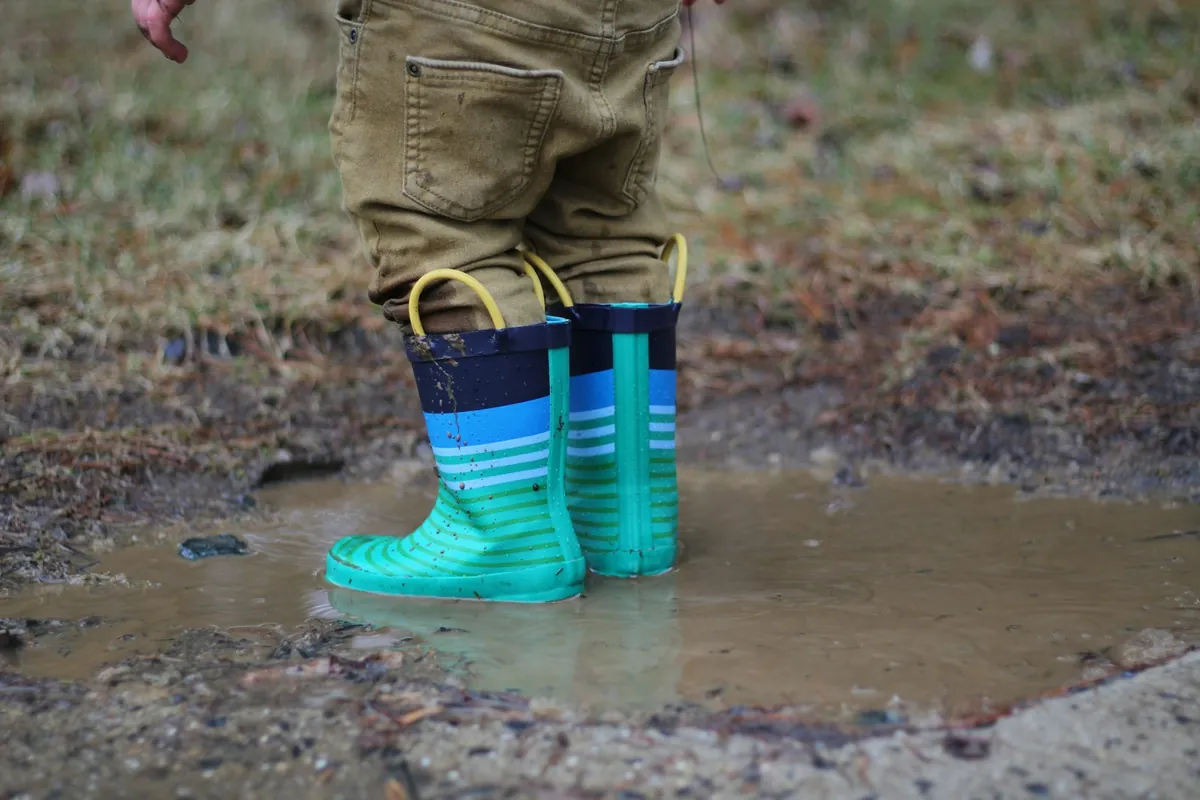
Waterproofs and wellies convert most of the outdoor list back into a usable list, and a puddle is a genuine attraction to a two-year-old rather than a consolation prize. Twenty minutes of stamping in water does more for a wet afternoon than an hour of anything indoors. The National Wildlife Federation makes the broader case for getting children outside regularly, and none of it depends on the weather being good.

Two practical notes. Get the gear right once, because a child in leaking boots will never enjoy this. And plan the wet outing as a shorter, brisker version of a dry one, with the warm stop deliberately at the end rather than squeezed in when everyone is already cold and miserable.
The at-home day, done properly
Some days nobody is going anywhere. Those days go better with a shape too.
A workable indoor day
- Something physical in the morning. Cushions on the floor, dancing, anything that uses legs.
- One absorbing thing, not five short ones. Messy play, dough, water in the sink.
- A change of room after lunch. New space resets a toddler more reliably than a new toy.
- A den. Chairs and a blanket, twenty minutes to build, an hour of value.
- Accept one screen slot if you need it, at a fixed time rather than by attrition.
Rotating toys helps more than buying them. Put two thirds away and swap the boxes every few weeks; the same toys reappearing after a month are, to a toddler, new toys.
Getting everyone into waterproofs is its own problem — see coats, shoes and getting out the door.
The afternoon slump
The hardest part of a wet week is not the morning. It is the two hours between the end of the nap and the start of dinner, in the dark, indoors, when everyone has run out of patience.
Plan for that stretch specifically rather than hoping it passes. The things that work in it are low-effort and repeatable: a bath brought forward an hour, cooking together, a den, or simply going out into the dark for ten minutes because the change of air resets everyone.
What does not work is starting something ambitious at four o’clock. That is the worst possible time to begin a craft that needs supervision.

Getting out of the house is usually the answer
Even a short outing changes the shape of a wet day out of all proportion to its length. Forty minutes somewhere else resets a toddler, and more importantly it resets the adult, which is usually the limiting factor by the third week.
This is what indoor play spaces are for during the wet months. Not as a treat, but as infrastructure: somewhere warm, dry and physical that does not depend on the forecast. Our guide to indoor play for toddlers covers choosing between the options, and our roundup of indoor activities in Milwaukie lists what is nearby.
For the at-home slot, our guide to messy play covers the one activity type that reliably absorbs a toddler for a proper stretch. Our visit page has our opening hours.
Illness season overlaps with all of it
The other thing nobody plans for is that the wet months are also the months everyone is ill. A rhythm built on the assumption of a healthy week collapses the first time somebody has a temperature on a Tuesday.
Build the fallback in rather than treating it as a failure. One low-effort thing, no guilt, and no attempt to make up the missed session later. If your anchor session is missed two weeks running, it is still the anchor — go back to it the following week rather than concluding the routine has collapsed.
It is also worth being straightforward about staying home when a child is genuinely unwell. Nobody at a play space wants the bug, and going back a week later is much better than being the family who brought it.
If you are going often enough to consider a pass, see our guide to whether a play pass is worth it.
Lower the standard, deliberately
A good week in February is not a week of enriching activities. It is: everyone got outside most days, nobody was ill for long, the afternoons were survivable, and you did not spend the whole month feeling you were failing at something.
The families who cope well with a long wet winter are not the ones doing the most. They are the ones who decided in October what the week looks like, and then stopped deciding.
Frequently asked questions
How do I keep a toddler busy on rainy days?
Build a weekly rhythm rather than a list of activities. One predictable anchor, one free option, something physical each day, an at-home slot and a low-effort fallback removes the daily decision, which is the part that actually wears you down.
Should we still go outside when it is raining?
Yes, in the right gear. Rain cancels sitting about rather than moving, and puddles are a genuine attraction at this age. Keep wet outings shorter and put the warm stop at the end.
How long should an indoor activity last for a toddler?
Fifteen to twenty minutes of real absorption is a full session. One absorbing activity works better than five short ones, and ending while it is still going well makes the next one easier to start.
What helps with the late afternoon on a wet day?
Plan for it rather than hoping it passes. An early bath, cooking together, a den, or ten minutes outside in the dark all work. Starting something ambitious at four o’clock does not.
Does rotating toys actually help?
It does. Putting two thirds away and swapping the boxes every few weeks means the same toys reappear as new ones, which is considerably cheaper than buying more.